
Published by Moyo Care - 31 May 2026
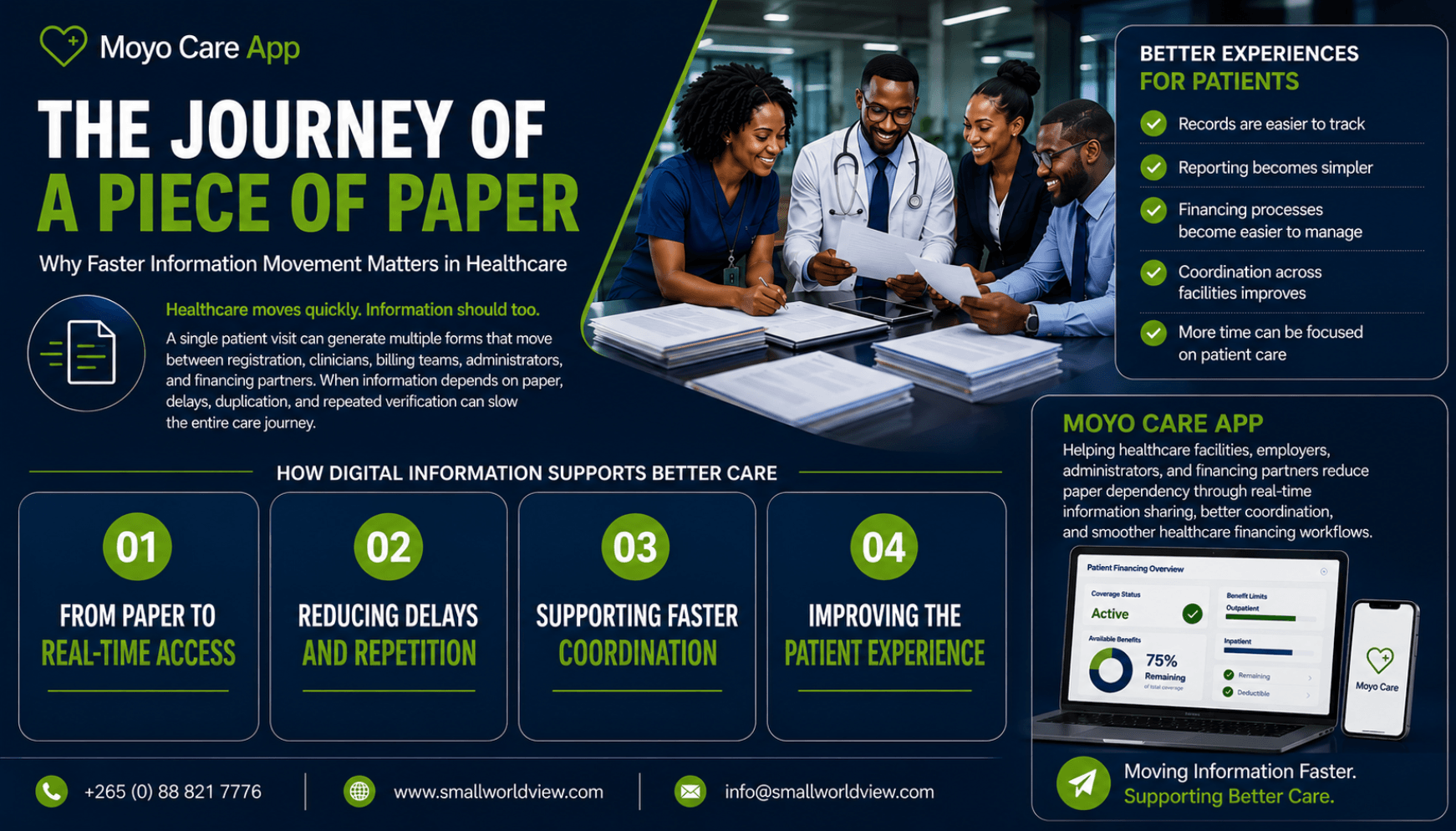
The goal is not simply to replace paper. The goal is to help information arrive where it is needed without unnecessary delays, duplication, or repeated effort.
A patient arrives at a healthcare facility seeking care.
At registration, a form is completed.
The form moves to another desk for verification.
From there it may move to a clinician, then to billing, then to an administrator, and eventually to whoever is responsible for financing the service.
By the time care is completed, a single patient visit may have generated several pieces of paper, each carrying information needed by someone else in the process.
For many years, this approach has helped healthcare facilities keep records, communicate decisions, and support healthcare financing workflows.
But as healthcare financing arrangements grow, the journey of that paper often becomes longer.
Patients move through healthcare facilities relatively quickly.
Information does not always move at the same speed.
A financing approval may be waiting in one office while a patient waits in another.
A claim may be ready for review but still needs supporting documentation from somewhere else.
A report may require information that already exists on another form.
None of these situations are unusual. They are part of the reality of managing healthcare services across different organizations and financing arrangements.
The challenge is that healthcare delivery becomes increasingly dependent on how quickly information can move.
When people think about healthcare financing, they often think about funding, benefits, or payments.
Less visible is the amount of administrative work required to support those processes.
Someone has to:
When these activities depend heavily on paper, the workload grows with every additional patient, facility, and financing partner.
Over time, administrative effort can become just as important as the financing itself.
Digitization is often discussed as a technology project.
In reality, it is often an information movement project.
The goal is not simply to replace paper.
The goal is to help information arrive where it is needed without unnecessary delays, duplication, or repeated effort.
When healthcare workers can access information directly:
The focus shifts from moving paper to supporting care.
Patients usually notice the effects of paperwork long before they see the paperwork itself.
It may appear as:
These experiences provide valuable insight into where healthcare processes can be improved.
Employees and patients can help by sharing practical feedback about where delays occur and which processes feel unnecessarily complicated.
Some of the most effective improvements in healthcare financing begin with simple observations from the people using the system every day.
As healthcare financing arrangements continue to expand, the ability to move information efficiently becomes increasingly important.
Moyo Care supports healthcare financing workflows by helping healthcare facilities, employers, administrators, and financing partners access and share information in real time.
This helps reduce dependence on paper-based processes while supporting faster coordination, easier tracking, and smoother healthcare financing operations.